Welcome!
Dear Reader,
Welcome to the TIC Efficiency Program’s third quarterly newsletter. Here, we’ll share with you: lessons learned from teams working on efficiency, an overview of what we’re implementing (efficiently), and other efficiency-related resources we find in the MSF universe and beyond. We’ll also try to inspire you and your teams with tools and examples as we try to promote a culture of continuous improvement and contribute to the long-term sustainability of MSF’s social mission.
What’s new in the Efficiency Program?
As of December 1, 2022, we have 6 active projects in the portfolio spanning from supply chain to financial engineering, as summarized in the table/infographic below.
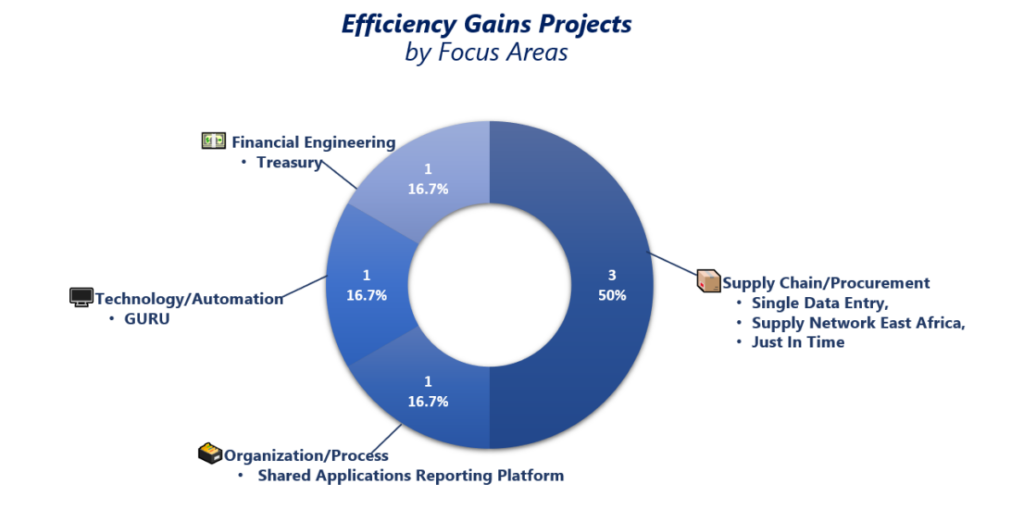
source: Efficiency Program, 2022)
During our two most recent Selection Committee meetings (October 25-26 & November 30, 2022), the Selection Committee:
- Approved a budget extension for the Shared Application Reporting Platform (ShARP) project
- Received a Phase II proposal (roll out phase) for the Treasury International Centre project. If you’re interested in learning more about the Treasury project, click here for a feature in our previous newsletter.
- Conducted 6-month project reviews for the following:
- GURU, Virtual Knowledge Assistant feasibility study,
- Just-in-Time Distribution incubator,
- Supply Network East Africa (SNEA) incubator (to find out more about this project, keep reading!)
As part of our own efforts to continually improve our processes and facilitate the work of MSFers contributing to MSF transformation, the TIC Secretariat is thrilled to share a few recently developed resources:
- TIC User Guide, which provides details on proposal requirements, applications and managing TIC projects
- TIC Project Portal – the place to go access information on previous and existing TIC projects, including those in the Efficiency Gains cluster.
Project Highlight: Supply Network East Africa
In October, 2022 the TIC Selection Committee met for an in-person meeting in Nairobi. For those unfamiliar with the TIC model, the TIC Selection Committee – a collective of international, experienced MSFers and external thought leaders – comes together to evaluate new and existing TIC projects 8 times per year. This in-person meeting was the first the group had had since the beginning of the Covid-19 pandemic. The
Committee met in Nairobi, where the TIC has over 10 projects with impact in the region, including one of the Efficiency Program’s very own, the Supply Network East Africa (SNEA) project.
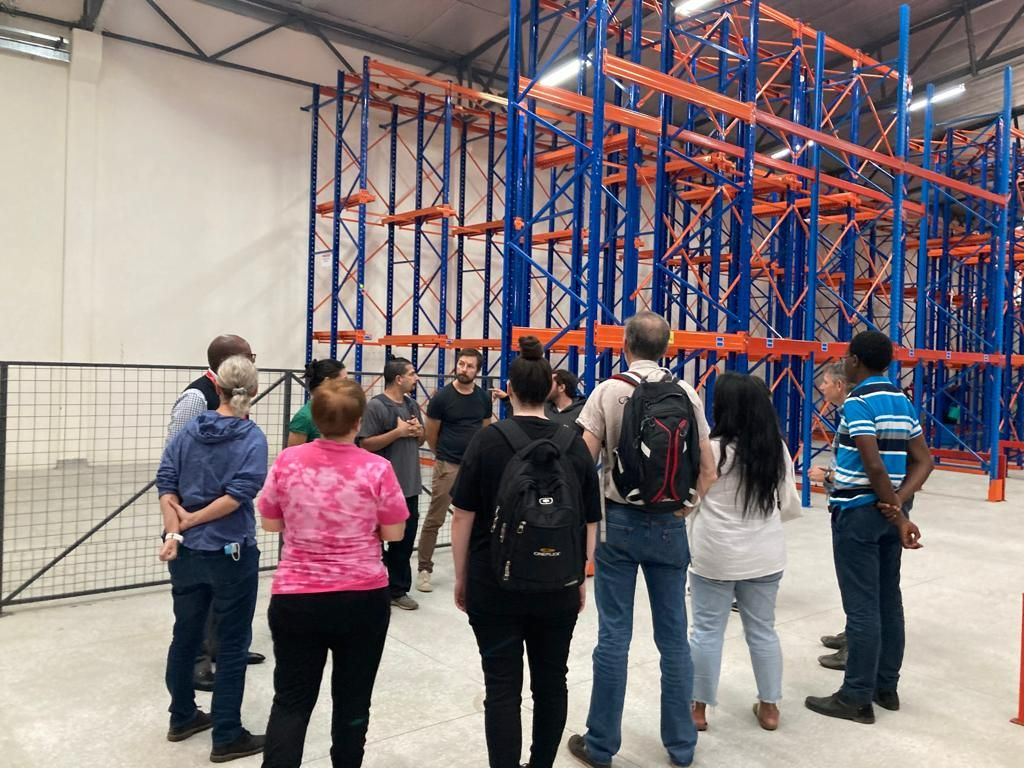
The Supply Network East Africa (SNEA) project has been running for almost a year, and the Selection Committee had the opportunity to visit the almost-ready warehouse, where we learned about the foundational supply network in the region.
Based on a collaborative approach between European Supply Centres (ESC)/OCs and Regional Supply centres (i.e., Support Unit Kampala (SUKA) and Kenya Supply Unit (KSU)), the aim of this project is to create a unified supply network to optimize the use of MSF resources and reduce activity duplication in existing structures in the region.
The project is working on redesigning the distribution network for a specific list of 80 high-volume items (for example, gloves), which are costly to transport.
MSF activities in East Africa cover 1/4 of all MSF Operations. Around 40% of large-volume items are shipped by air from the ESCs to the region (data based on a report from 2016-2019). Rather than detouring to the ESCs, bulky items can be shipped directly from suppliers to the network and then dispatched to the missions, resulting in efficiency gains related to resource management, carbon footprint and effectiveness as summarized in the infographic below.
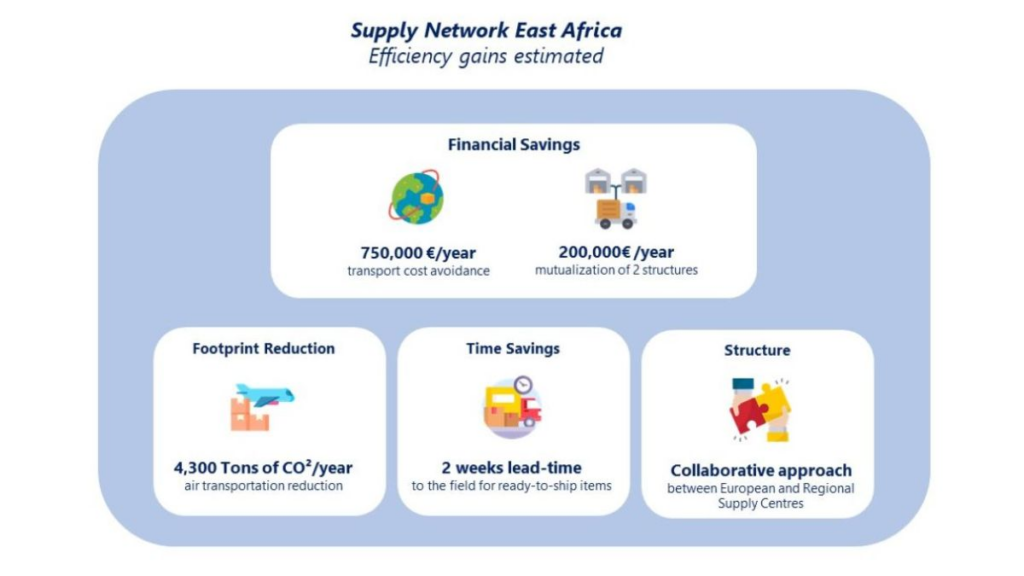
We asked the Supply Network project team to share key learnings from their experience in running the TIC project so far.
A message from Antoine Segui, the project manager:
““I have been working on the SNEA project for over a year now. This project will contribute to a redesign of our movement supply network. Our supply chain complexity has brought some challenges in the progress of the project, but it is moving, step-by-step, in the right direction.
Managing the project with the TIC has enabled me to better frame the concept note, covering all the elements from a project perspective, while receiving good questions helping to reflect on the direction taken.”
The team suggested to:
- Establish clear goals at the start of large Steering Committee meetings
- Involve the legal department early to help in identifying and mitigating potential challenges/risks (the team has faced challenges in registering MSF Supply in Kenya)
If you are interested to find out more about this project, please reach out to the TIC team (tic@msf.org).
Update on projects linked to the Core+ on Efficiency in Support to Operations
Phase 1 of the Efficiency in Support to Operations project ended in January 2022. A report was shared on the outcomes by the Core+. See below for the latest updates on selected projects identified as “key” in the implementation of the efficiency in support to operations statement.
Update on the Full Organizational Supply Strategy implementation:
The International Office has initiated an exercise to determine a joint strategic direction on supply chain for the coming years. This work is being coordinated by the ESCC, and at this time the ESCC has defined 6 transformational topics for focus:
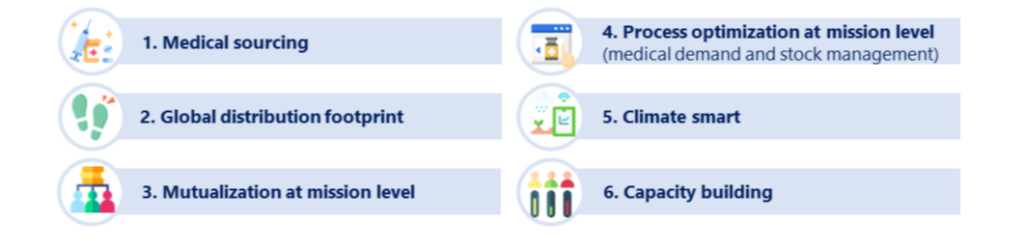
To deep dive on getting these transformational topics, the Supply Chain team conducted a review of previous supply chain projects, performed a detailed data analysis, and held over 75 internal and 35 external interviews.
The scoping and approach were discussed and validated with the DirMed platform and a broad group of pharmacists earlier this year, followed by the launch of a joint Supply/Pharma working group across OCs to discuss mission-related approaches. Specific ESCC meetings are being carried out to determine the final strategy and next steps. These transformational topics are scheduled to be reviewed by the Core ExCom in 2023 Q1, followed by the Full ExCom.
Update on the MSF Data and Systems Interoperability proposal:
The ISM platform has evaluated the advantages and disadvantages of a movement-wide data strategy and has prepared a report which:
- Captures data strategy components, the role of data in improving interoperability at MSF, existing efforts to develop data strategies and the pros/cons of a global data strategy
- Highlights the following data strategy case studies:
- Section-level data strategy approach and planning in OCA, OCBA and OCG
- Intersectional Health Data Strategy concept paper recently approved by the DirMed platform
- The Shared Application Reporting Project (SHARP), supported by the TIC
- The International HR Data & Analytics Roadmap assessment
Inspiration Corner – Root-Cause-Analysis (RCA)
There are many words and concepts that belong to the so-called efficiency dictionary, including one of our very favorites: “process optimization”. We are often approached by teams in search of improving their workflows and if you can relate to this sentiment, perhaps you would find the root-cause analysis (RCA) exercise helpful.
Similar to a medical diagnostic, RCA is a problem-solving method that investigates the “symptoms” with the aim to understand the root causes leading to the “ailment”. Once those are identified, a “cure” can be developed to address these causes and prevent recurrence.
RCA can be summarized in 5 steps:
- Define the problem
- Collect data
- Identify possible causal factors
- Identify the root cause
- Recommend and implement solutions
If you are interested to learn more about RCA, have a look at the video below:
A Year-end Challenge for You and Your Teams
Are there aspects of your daily tasks that frustrate you and your team the most? Try out with your team your own root-cause analysis with the “5 whys” technique.
It is difficult to identify the inventors of RCA analysis, however, the first appearance in the engineering discipline is credited to Sakichi Toyoda, founder of Toyota Industries. He improved RCA by implementing a technique called the “5 whys” (source). The 5‐Why analysis is the primary tool used to determine the root cause of any problem.
After you’ve carried out the exercise, discuss with your colleagues how this methodology might be applied or improved in your workspaces. Maybe you’ll come up with a few improvement ideas? Let us know by email if you’ve tried the exercise and whether you enjoyed it.
Thank you for reading until the end, we hope you enjoyed it!
Wishing you all a serene festive season and a new year full of continuous improvement opportunities!!