Welcome!
Dear Reader,
Welcome to the next series of the TIC Efficiency quarterly newsletter! Here, we’ll share with you lessons learned from teams working on efficiency, an overview of what we’re implementing (efficiently), and other efficiency-related resources we discover within and beyond MSF. Thank you for joining us on this journey towards greater efficiency.
What’s New In The Efficiency Program?
From Efficiency Program to TIC Efficiency Capacity
December 31, 2022 not only marked the close of the year, but also the completion of the Efficiency Program 3-year Full ExCom mandate, implemented through a partnership between MSF-Germany and the TIC. In view of its completion, a self-evaluation of the Efficiency Program was conducted in Q3/Q4-2022, including desk and interviews analysis with 18 key stakeholders who provided their valuable input. Strengths, challenges, and opportunities were identified, and recommendations were made. After careful assessment of the outcome, the TIC Core Team (TIC Steering Committee) and Christian Katzer (MSF Germany General Director, and Efficiency Program host) have determined that the program has reached its natural conclusion. Starting this year, the program is continuing as a capacity for efficiency-related projects within the TIC, consistent with the Core ExCom decision to add a 4th focus area to the TIC for Efficiency & Effectiveness.
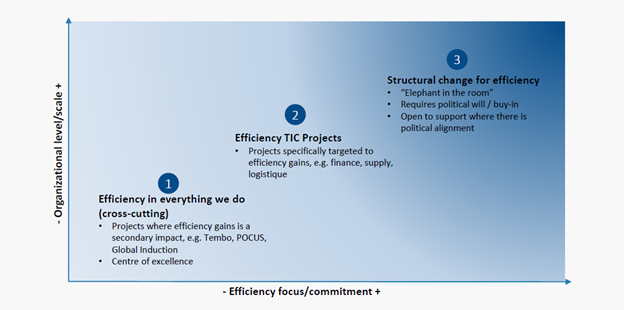
This capacity will contribute to MSF efficiency efforts via three means (as summarized in the infographic above): embedding efficiency & effectiveness as cross-cutting requirements in everything we do, funding projects specifically targeting efficiency gains and support to structural changes for efficiency when political alignment exists.
We express our gratitude to all those who participated in the program and evaluation, and we remain committed to our mission of transforming MSF into a more efficient organization. We would also like to extend our heartfelt thanks to Stephanie Winitsky (Program manager) and Juliet Barbieri (Program Assistant) for their past contributions.
We are excited to announce that the TIC Secretariat, with support from MSF-Germany, is currently at the final stage of hiring a Project Manager with a focus on Operations and Efficiency to lead the efficiency capacity, as we work together to achieve efficiency goals.
TIC Efficiency Gains Projects updates
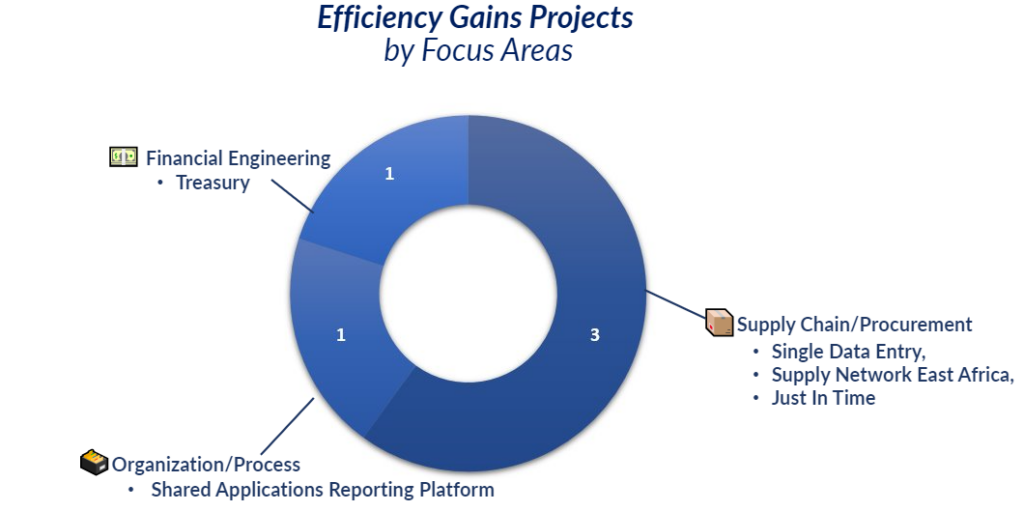
As of April 1, 2023, the TIC Efficiency Gains portfolio currently consists of 5 active projects which cover supply chain, financial engineering, and support to operations, as summarized in the table/infographic below:
During our most recent Selection Committee meeting (March 29, 2023), the Selection Committee:
- Recommended approval of a Phase II large-scale proposal (sponsored by OCB and supported by OCP, OCG and OCBa) for the Supply Network East Africa (SNEA) project, pending Core ExCom endorsement
If you’re interested in learning more about the SNEA project, click here for a feature in our previous newsletter.
- Conducted 6-month project reviews for:
- Shared Application Reporting Platform (ShARP)
- Supply Network East Africa (SNEA) incubator
Project Highlight: Single Data Entry
We are thrilled to share that the Single Data Entry project launched its third phase at the start of March, following the appointment of the new Program Manager, Zineb Félix.
For those of you who are not familiar with the project, the Single Data Entry project, as the name suggests, aims at addressing supply chain related issues caused by multiple data inputs and often manual (paper and pencil) input of data, contributing to MSF Supply Chain Transformation vision and strategy.
In 2015, the Executive Supply Chain Committee (ESCC) performed a supply chain benchmark highlighting that all Operational Centers’ supply chains show an important lack of visibility due to poor data availability and quality, which limits supply chain efficiency. Within the supply chain, the same data is entered into the system multiple times with the risk of encoding error and time-consuming administrative burden. The operational impacts of these issues are high HR costs, waste due to expiry, risk of stockouts, and longer response time to emergencies.
The project has gone through three phases, starting with a feasibility study in 2017, a Proof of Concept (PoC) in 2018, and further research on new technologies in 2021. The current phase, Phase 3, aims to select and deploy a scanning and reading technology in all international medical supply chain nodes, from the European Supply Centres (ESCs) to the in-country project locations and create the SDE mobile application using multiple technologies to improve the efficiency of three key stock management processes across MSF Operational Centres (OCs).
The Single Data Entry (SDE) envisioned solution will change how the supply or pharmacy team at each location will carry out their daily tasks during the reception, order preparation, and stock count using a mobile application, instead of using paper and pencil and manually entering information into the existing MSF stock management tools.
We asked Single Data Entry project team to share key learnings from their experience in running this TIC project so far. What follows is a message from the Program Manager Zineb Félix:
“Since I joined MSF and took over the Single Data Entry (SDE) program in early March 2023, I have been thrilled by the enthusiasm our colleagues from the different Operational Centres (OCs) and European Supply Centres (ESCs) have shown for this initiative.
The SDE is an extensive, important TIC program for the MSF movement, which went through multiple incubators in the past years and is now up for implementation. The expectations are high, and the opportunity is unique to leverage the momentum around the program and the need to improve the efficiency of stock management processes across MSF OCs.
My hope for the SDE is to successfully bring people together to deliver the digital solution that will effectively address the challenges of the project’s target users- the 1000 field staff performing the key stock management processes at the projects’ locations. The SDE team will aim to design the mobile solution inclusively by ensuring that target users are involved as co-creators and that their perspectives are fully integrated into the solution development and deployment.”
If you are interested to find out more about this project, please reach out to the TIC team (TIC@msf.org).
Update on projects linked to the Core+ on Efficiency in Support to Operations
It has been a year since the Efficiency in Support to Operations project entered Phase 2. See below for the latest updates on selected projects identified as “key” in the implementation of the efficiency in support to operations statement.
Update on MSF Data and Systems Interoperability (led by ISM)
The ISM platform has evaluated the advantages and disadvantages of a movement-wide data strategy and has delivered the “Global Data Strategy” final report. It includes an overview of key definitions and concepts, and how these relate to our organizational ambitions to achieve greater interoperability and efficiency in pursuit of our social mission. The report also highlights a sample of current efforts underway in MSF to develop data strategies and examples of projects tackling common data management challenges.
Update on the Supply Chain Roadmap and Implementation (led by ESCC)
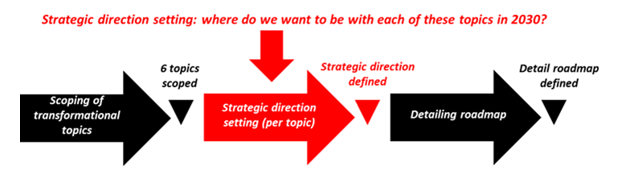
After identifying the 6 focus transformational topics (as summarized in the previous newsletter, available here), the ESCC is currently finalizing the strategic directions setting for each of these topics (planned by June this year). After this, the next step will be to elaborate a detailed roadmap, as shown in the infographic below:
Over the past year, to develop well-informed and effective proposals, the ESCC has conducted: interviews with over 75 colleagues within MSF, a benchmark analysis gathering learnings from the supply chains of nearly 30 external companies and organizations, and a data-based analysis. Based on these insights, proposals were drafted during two ESCC retreats.
Currently, during the first half of 2023, the proposals are being discussed with various stakeholders, particularly colleagues in the medical, operations, logistical, and financial departments across different MSF entities. The ESCC plans to seek endorsement of the proposals in mid-June at the Core ExCom meeting. This step will be followed by sharing the proposals with the Full ExCom in autumn.
Inspiration Corner – Corrective and Preventive Actions (CAPA)
In the previous newsletter, we explored the root-cause analysis (RCA) approach as a part of process optimization, check here the previous newsletter, if you missed it. This time, we would like to introduce you to the Corrective and Preventive Actions (CAPA) approach.
Continuing with our medical diagnostic analogy, once the root causes leading to an ailment have been identified through RCA, it is time to develop a treatment plan. In the context of process optimization, the “cure” can come in the form of Corrective and Preventive Actions (CAPA).
CAPA is a method for addressing the root causes identified in the RCA process and developing a plan to correct, and therefore eliminate, and prevent them from happening again in the future. To learn more about CAPA and its implementation and refresh your knowledge on RCA analysis, you can view this video:
Thank you for reading until the end, we hope you enjoyed it!
Have any feedback? We are always looking for ways to improve. Send us an email.