
Welcome!
Dear MSF colleague,
Welcome to the Efficiency Program’s Q2 newsletter. Via this channel, we’ll share with you: lessons we’ve learned from efficiency project teams, an overview of what we’re working on (efficiently), and all other efficiency-related resources we find in our MSF universe and beyond. We’ll also try to inspire you and your teams with tools, videos and efficiency challenges, with an ultimate goal of promoting a movement-wide culture of continuous improvement and contributing to the long-term sustainability of MSF’s social mission.
What’s new in the Efficiency Program?
In our first newsletter, we provided an overview of projects in our TIC efficiency portfolio. As of today, we have 4 active projects and 2 project proposals in the TIC application process. Projects cover areas spanning topics of supply chain, finance, knowledge management, as summarized in the infographic below:
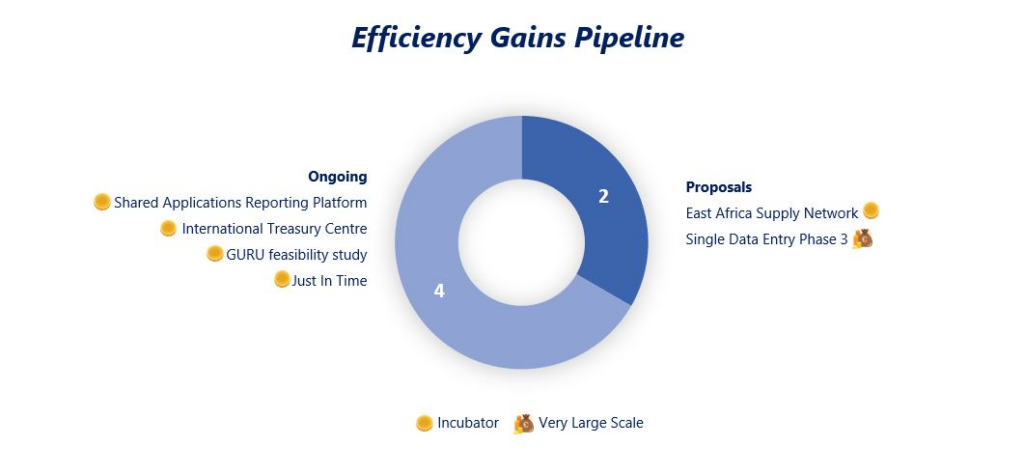
source: Efficiency Program, 2022)
Alongside the TIC portfolio projects, the Efficiency Program is actively supporting two teams in MSF-Germany:
- Process optimization in the Legacy team: A relatively new function in the organization, the Legacy team has experienced a lot of growth in case numbers and team members over the last few years. We are working together with the team to define and achieve maximum value in their work, and within the constrains of their current systems. If you work or have previously worked in an internal legal / legacy team and would like to share your experience(s) in efficient case management, please reach out to us!
- Design-thinking with the Berlin Knowledge Lab: we helped to plan a design-thinking-inspired workshop for the Pedriatic Working Group. If you or your teams are interested in discussing Design Thinking principles, get in touch!
If you would like to learn more about the projects in our portfolio, please visit the following link. If you have more than “just a vague idea” of what you would like to see worked on and you would like to submit a proposal through the TIC, please visit this page.
Project Highlight: International Treasury Centre Pilot
It’s been a little over a year since the TIC Efficiency Program welcomed the International Treasury Centre Pilot project, which aims to reduce the limitations and relatively high opportunity costs linked with excess “idle” cash in the movement and smooth the impact of currency fluctuations, which are currently separately managed by MSF’s various entities.
The proposed solution is an international treasury center, with two primary strategies:
- an international cash pool for Euros and US Dollars, and
- an in-common hedging strategy and tool
In combination, these strategies leverage the movement-wide excess cash position in financial markets; apply a consistent approach to covering currency risk; employ MSF’s own liquidity before turning to expensive external loans; and allow the movement to collectively benefit from treasury expertise. The model will also increase coordination of transactions, lessen non-competitive banking fees, and decrease the need for last-minute inter-OC emergency transfers to cover short-term cash needs. And, it has now been successfully tested in two pilot studies.

MSF delivers $17m to Pfizer to get them to drop the price of the pneumonia vaccine – click here for more info
We asked our International Treasury Centre project team to share key learnings from their experience in running this TIC project so far:
- We should prepare for the downside when things are good: MSF is currently in a comfortable financial position, but this can change quickly, especially as we consider economic forecasts. It can be hard to predict / communicate this meaningfully.
- United, but all different: performing a legal analysis for each organizational entity in advance is necessary since MSF entities are subject to the local laws of the country where they are based. Carrying out a legal analysis can take a long time given the legal form of our entities and the way we are organized as a movement, which is not the usual model that lawyers and authorities are used to. The implementation of a common model may imply different configurations for each entity depending on legal obligations and internal processes and needs.
- “Different speed” model: the MSF movement is made up of organizations that make autonomous decisions and have different management and governance models. While working towards a common model, it is natural that it be gradually implemented to allow the different entities to prepare and adapt to the new processes, also according to their available resources.
- Existing knowledge and adapted communication strategy: when implementing a new project, we need to consider the stakeholders background and skills. Good communication tailored to the level of understanding of each of the interlocutors and inclusive participation, especially of those with relevant knowledge, is key to a smooth and successful implementation.
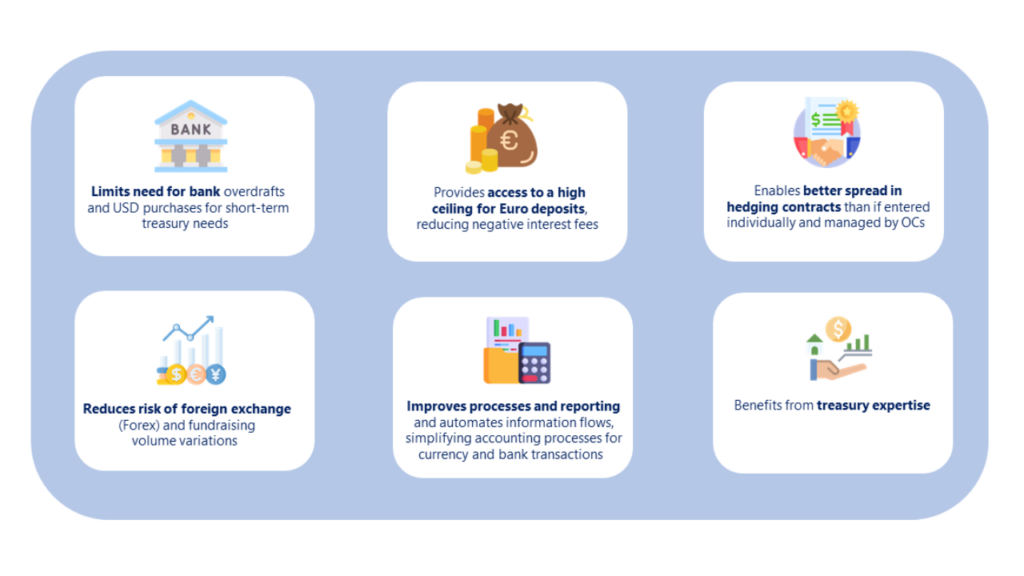
Some of the efficiency gains that this project aims to achieve are summarized in the infographic below:
A message from Susana Lopez, the project manager:
“Working on this project has made me realize how important it is to look outward and take advantage of great opportunities to improve our organization at all levels. Over the last years, the MSF movement has grown into a large and complex organization that requires a high degree of professionalization. We should not be afraid to learn from others, including entities in the for-profit sector. Implementing professional practices and specifically in the field of finance does not mean losing our humanitarian essence, on the contrary, it means trying to make the most efficient and effective use of the resources that so many people in the world have entrusted to us for populations in great need of humanitarian assistance.
It is especially in times of good financial situation like the one MSF is experiencing now, that we need to work even harder to manage our resources as efficiently as possible. Being prepared for less favorable economic circumstances will help us better cope with them. We owe it to our donors, but we especially owe it to the populations we assist
My hope is that by successfully implementing these efficiency-focused projects, the MSF movement, and its many entities, while maintaining the diversity that represents such great value, will be more open to further promoting mutualization in areas where it brings real efficiency gains for the organization.“
Update on projects linked to the Core + on Efficiency in Support to Operations
Phase 1 of the ‘Efficiency in Support to Operations’ project ended in January 2022. A report was shared on the outcomes by the Core+. In the report, 4 projects were identified as “key” to improving efficiency in support to ops project success. See below for Q2 updates on these projects:
Update on the HR Global Grading Framework (a Rewards Review deliverable):
- In 2022 we started, with the help of Korn Ferry consultants, to develop the individual Job Families that will make up the Global Grading Framework
- We are now involving content owners and relevant stakeholders across the organization to provide input into their specific function families, and aim to develop around 45 job families to cover all jobs in the organization
Update on the MSF Data and Systems Interoperability proposal:
- Delivery of pros/cons of global data strategy and recommendations for moving forward from ISM will be delayed to end of September
- ISM completed first prioritisation exercise for global IT portfolio in a meeting in May
- Interoperability dossier will be focused on what standards in data and integration are needed to achieve/enhance interoperability in our systems architecture. This will likely be worked on in 2023
- The first part of an assessment for reporting optimisation for International HR data was completed, with key processes mapped and data quality gaps/challenges identified in an as-is process. Summary of these challenges found in section 2c of 2021 MSF Staff and Data Trends Report. Tender process for procuring external expertise for designing future-state technology and process roadmap is underway, with kick-off of part 2 of the assessment slated for October this year
Update on the ESCC road map:
- Approach determined and agreed upon by ESCC, in collaboration with DirMeds (many transversal topics) & Core ExCom
- The approach includes interviewing key stakeholders, external companies and humanitarian organizations for reference, and extensive stakeholder management
2022 OCA LogCo Days
The 2022 OCA LogCo Days took place on May 29–June 3 in Nairobi, with an important efficiency and mutualization topic on the agenda titled “Intersectional Collaboration: when is it beneficial?”
Olaf Pots (Logistics Coordinator International) and Stephanie worked to present the findings of the Efficiency in Support to Operations report and introduced the group to the role of the Efficiency Focal Point.
Efficiency Program x Ops Community Webinar
On July 14th, we hosted a webinar for the Ops Community with help from Martin Seale (Analysis Director, HK). 67 colleagues showed up to learn about projects with a focus on achieving operational support efficiency, both past and present.
Martin shared highlights from his work on the ‘Efficiency in Support to Operational Support’ project, covering elements of the preliminary research into when and why attempts to improve support to ops efficiency succeed and when and why they do not.
Stephanie covered how we can use this information in current and future projects, and where the outcomes of this work now live.
Inspiration Corner – Kanban
If you are familiar with tools like Trello or Asana and their layouts, then the term “Kanban” may not be new to you. However, Kanban is more than just a pretty inter-face. It’s a popular Lean workflow management method that helps teams to visualize workflow, maximize efficiency, and improve continuously. The Japanese word “kanban” means “visual board” or “sing” and has been used in the sense of a process definition since the 1950s.
It was developed by Toyata as a just-in-time scheduling system for manufacturing. It then became a valuable tool in Agile software development teams, until its more recent recognition by business units across various industries.
We suspect that many of our readers are already users of a version of the Kanban. For those of you who want to learn more, see below for a fun and easy video you can watch with your teams with explains Kanban with a coffee cup:
A Q3 Challenge for You & Your Teams
If you are looking for something more filling than coffee, what about a Pizza? The Kanban pizza game is a great way to gain experience with the Kanban method in a quick and fun way. It works nicely with both new and established teams. The Kanban Pizza Game teaches you how to get from an existing process to a Kanban system, how to visualize it and start modifying it. Below you can find useful links to carry out this exercise with your team, both online and offline:
Offline instruction: https://toolbox.hyperisland.com/kanban-pizza-game
Miro board: https://miro.com/miroverse/kanban-pizza-game/
After you’ve played, discuss with your colleagues how this methodology might be applied or improved in your workspaces. Maybe you’ll come up with a few improvement ideas? Let us know by email if you’ve tried the game and whether you enjoyed it.
Thank you for reading until the end, we hope you enjoyed our Q2 newsletter!